Most students understand how to register and submit an application on the MPTAAS portal, but very few know what happens after clicking the final "Submit" button. The real decision-making process begins only after submission. The approval of a scholarship is not automatic; it moves through multiple institutional and administrative checkpoints before the amount is credited to a student's bank account. https://mptaasscholarships.com/
The Madhya Pradesh Tribal Affairs Automation System (MPTAAS), managed by the Department of Tribal Affairs and Scheduled Caste Welfare under the Government of Madhya Pradesh, operates through a structured district-level workflow. This article explains the internal approval chain, verification layers, accountability structure, payment routing system, and common bottlenecks that affect the processing of applications.
Understanding this workflow helps students anticipate delays, correct mistakes early, and track their application status more intelligently.
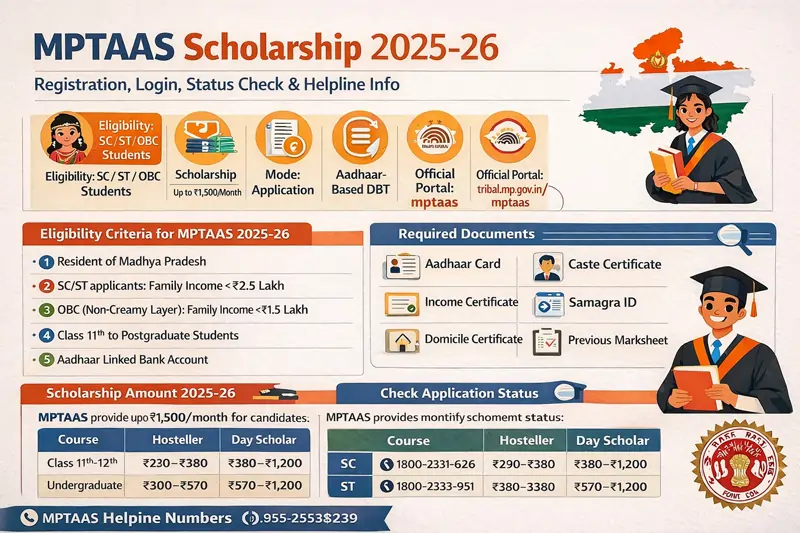
1. Overview of the MPTAAS Approval Architecture
1.1 Institutional Hierarchy Involved
After submission, an application passes through several levels: student level (data entry), college level verification, district welfare office scrutiny, sanction authority approval, treasury and fund allocation, and direct benefit transfer processing. Each stage has defined responsibilities and digital checkpoints. The system is designed to minimize duplication, fraud, and manual interference.
1.2 Digital Integration Components
The approval mechanism is supported by integrations with Aadhaar authentication systems, Samagra ID database (Madhya Pradesh family database), bank account validation systems, NPCI mapper for DBT routing, and departmental scholarship management dashboards. These integrations ensure cross-verification of identity, income, and academic status.
2. Stage One: College-Level Verification
2.1 Role of the Institution
The first authority to review an application is the educational institution. The college login dashboard allows designated officials to confirm student enrollment, verify admission year, check course category and duration, validate attendance status, and cross-check fee structure. Without institutional verification, the application does not move forward.
2.2 What Colleges Actually Check
| Verification Parameter | Purpose |
|---|---|
| Admission Record | Confirms genuine enrollment |
| Course Group | Determines scholarship rate |
| Previous Year Marks | Required for renewal |
| Fee Receipt | Validates claimed tuition |
| Attendance Status | Ensures active study |
If discrepancies are found, the application is marked for correction or rejected.
2.3 Common College-Level Delays
Delays at this stage typically arise from late result uploads in internal systems, incomplete fee record entry, mismatch between portal data and college records, and pending approval due to bulk application load. Students often assume the government is responsible for delays, but a large percentage originate at the institutional level.
3. Stage Two: District Welfare Office Scrutiny
Once verified by the college, the application is digitally forwarded to the district-level office of the concerned welfare department.
3.1 District Officer Responsibilities
The district scrutiny process includes validation of caste certificate authenticity, income certificate verification, domicile confirmation, cross-checking Samagra ID details, and checking duplication of benefits. District officers operate under defined scrutiny guidelines and timelines.
3.2 Income and Category Cross-Verification
Income data is compared against issuing authority records, income certificate validity period, and threshold limits defined for SC/ST/OBC categories. Any inconsistency may lead to temporary suspension or rejection.
3.3 Risk Flags at District Level
Applications may be flagged for identical bank accounts used by multiple applicants, mismatched Aadhaar details, expired income certificates, or duplicate scholarship claims. Flagged applications are either sent back for correction or placed under manual review.
4. Stage Three: Sanction Authority and Fund Allocation
After district-level clearance, the application enters the sanction phase.
4.1 Sanction Order Generation
At this stage, approved applications are compiled batch-wise, course-wise amount calculation is automated, maintenance allowance and tuition components are separated, and a sanction order is digitally generated. The sanction order is an internal administrative document authorizing payment.
4.2 Scholarship Amount Calculation Logic
| Course Group | Hosteller Rate | Day Scholar Rate |
|---|---|---|
| Group I | Higher allowance | Standard allowance |
| Group II | Moderate allowance | Reduced allowance |
| Group III | Basic allowance | Minimal allowance |
| Group IV | School-level rate | Lower rate |
The system auto-detects the course group based on institutional classification.
5. Stage Four: Treasury and Budget Release
Even after sanction, payment is not immediate.
5.1 Budget Allocation Cycle
Funds are released according to annual welfare budget allocation, quarterly fund distribution, and departmental financial clearance. Applications approved late in the academic cycle may wait for the next fund release window.
5.2 Treasury Processing
Treasury verifies sanction file authenticity, total batch amount, departmental authorization, and budget head alignment. Only after treasury clearance does the file move to payment routing.
6. Stage Five: Direct Benefit Transfer Routing
The final stage involves DBT processing.
6.1 Bank Account Validation
Before crediting funds, Aadhaar must be linked with the bank account, the NPCI mapper must reflect the correct bank, and the account must be active. If any of these conditions fail, payment may show "Sanctioned but not credited."
6.2 Payment Status Categories Explained
| Status | Meaning |
|---|---|
| Pending at College | Institution not verified |
| Pending at District | Under scrutiny |
| Approved | Cleared for sanction |
| Sanctioned | Payment authorized |
| Paid | Amount credited |
| Rejected | Application closed |
Understanding these statuses helps students avoid confusion during the process.
7. Internal Audit and Fraud Prevention
7.1 Automated Risk Detection
The system detects multiple applications from the same family, bank duplication patterns, sudden income threshold changes, and repeated corrections in critical fields.
7.2 Manual Audit Triggers
Certain cases are manually reviewed, including high-fee professional courses, large batch approvals, and random sampling for compliance. Audit strengthens accountability but can extend processing timelines.
8. Timeframe Analysis of Each Stage
| Stage | Estimated Processing Time |
|---|---|
| College Verification | 7–20 days |
| District Scrutiny | 15–30 days |
| Sanction Processing | 10–15 days |
| Treasury & DBT | 7–14 days |
Actual timelines vary depending on academic season and fund availability.
9. Why Applications Get Stuck
Major bottlenecks include income certificate expiry, Aadhaar name mismatch, bank account dormancy, unlinked NPCI mapper, incorrect admission year in renewal, and college not syncing marks. Most issues are preventable if documents are verified before submission.
10. Strategic Advice for Students
10.1 Before Submission
Match name exactly with Aadhaar, ensure bank account is Aadhaar seeded, confirm income certificate validity, and check Samagra ID consistency before submitting the application.
10.2 After Submission
Monitor status weekly, contact college if status remains unchanged, track sanction updates, and avoid multiple edits unless necessary. Proactive monitoring significantly reduces uncertainty.
Frequently Asked Questions
Conclusion
The MPTAAS approval system is a structured administrative workflow rather than a simple online form submission process. From college-level validation to district scrutiny, sanction generation, treasury clearance, and final DBT routing, each stage plays a crucial role in ensuring that financial assistance reaches eligible students accurately and transparently.
Understanding this district-level verification workflow empowers students to identify delays, correct errors early, and engage with the system strategically. Instead of waiting passively, applicants who understand the backend process can actively monitor and resolve bottlenecks, increasing their chances of timely scholarship disbursement.